Louisiana Department of Wildlife and Fisheries

ROCKEFELLER WILDLIFE REFUGE

Acreage: 76,000 Acres
Owned: State of Louisiana
Parish: Cameron and Vermilion
Office:  Fur and Refuge Division
5476 Grand Chenier Hwy
Grand Chenier, LA 70643
Phone: (337) 538-2276
Email: gmelancon@wlf.louisiana.gov


  Map 1


Rockefeller Wildlife Refuge, located in eastern Cameron and western Vermilion Parishes, is owned and maintained by the State of Louisiana. When deeded to the state the refuge encompassed approximately 86,000 acres, but beach erosion has taken a heavy toll, and the most recent surveys indicate only 76,042 acres remaining. This area borders the Gulf of Mexico for 26.5 miles and extends inland toward the Grand Chenier ridge, a stranded beach ridge, six miles from the Gulf.

When the Rockefeller Foundation officially granted the property to the state, they spelled out in the Deed of Donation exactly how the property was to be used. The U.S. Fish and Wildlife Service makes periodic inspections of refuge activities and has reversionary rights over the refuge if the state fails to meet its obligations pertaining to the Deed of Donation, as amended.

The major terms of the original agreement stipulated 1) the property must be maintained as a wildlife refuge, 2) boundaries must be posted, 3) enforcement agents must protect the area from trespassers and poachers, 4) no public taking of fish or animals is allowed, 5) refuge staff must study and manage the property for wildlife, and 6) mineral revenues must be used on the refuge first (surplus may go toward education or public health). In 1983 the Deed of Donation was amended with a Memorandum of Agreement (MOA) between the Department of the Interior and the Louisiana Department of Wildlife and Fisheries. The MOA allows for regulated sport fishing and commercial trapping when compatible with the primary purpose of the refuge as a wildlife sanctuary. The MOA also allows surplus revenues to be used for land acquisition for wildlife management purposes. A 1987 MOA between the same two agencies ceased yielding surplus revenues for education or public health.

Planners had the foresight to realize that mineral revenues would cease at some point in time, and steps were taken to ensure that the refuge would be financially capable of operation and maintenance indefinitely. Act 321 of the 1972 legislature created the Rockefeller Wildlife Refuge Trust and Protection Fund (Trust Fund). One fourth of funds derived from royalties, rentals, or otherwise from Rockefeller mineral leases were to be deposited in the Trust Fund until a principal of $5 million was reached. Act 342 in 1978 raised the Trust Fund goal to $10 million. Act 807 in 1980 increased the Trust Fund goal to $20 million, and also established the Rockefeller Scholarship Fund for Louisiana wildlife students from 5% of interest from the Trust Fund. Act 63 of 1982 raised the Trust Fund goal to $30 million, and Act 707 of 1989 reduced additions to the Trust Fund from 25% to 5% of mineral revenues. Senate Bill 662 of 1989 established an annual donation of $150,000 to the Fur and Alligator Advisory Council, and Act 832 of 1995 raised the Trust Fund cap to $50 million.

Rockefeller Wildlife Refuge is one of the most biologically diverse wildlife areas in the nation. Located at the terminus of the vast Mississippi Flyway, south Louisiana winters about 4 million waterfowl annually. Historically, Rockefeller wintered as many as 400,000-plus waterfowl annually, but severe declines in the continental duck population due to drought and poor habitat quality on the breeding grounds have altered Louisiana's wintering population. More recent surveys indicate a wintering waterfowl population on Rockefeller Wildlife Refuge reaching 160,000. In addition to ducks, geese, and coots, numerous shorebirds and wading birds either migrate through or overwinter in Louisiana's coastal marshes. Neotropical migrant passerines also use the shrubs and trees on levees and other "upland" areas of the refuge as a rest stop on their trans-Gulf journeys to and from Central and South America. Although Canada geese no longer migrate to the refuge from breeding areas in the north as they once did, a resident flock of giant Canada geese was established in the early 1960s.

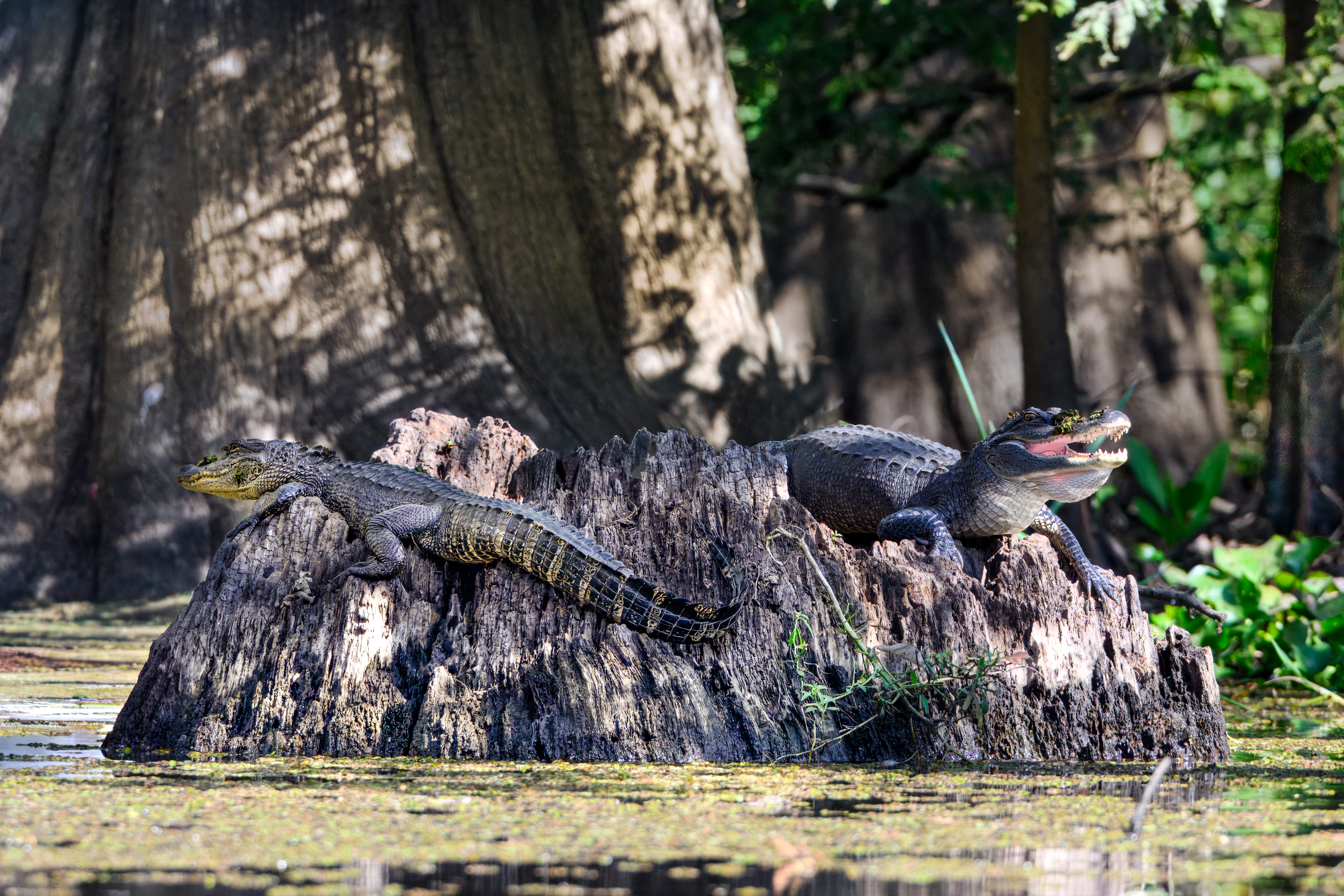
Common resident animals include mottled ducks, nutria, muskrat, rails, raccoon, mink, otter, opossum, white-tailed deer, and alligators. An abundant fisheries population provides recreational opportunities to fishermen seeking shrimp, redfish, speckled trout, black drum, and largemouth bass, among others. No hunting is allowed on the refuge, but some regulated trapping is allowed for furbearers that could potentially damage the marsh if their populations are not controlled.

The refuge is a flat, treeless area with highly organic soils which are capable of producing immense quantities of waterfowl foods in the form of annual emergents and submerged aquatics. Since 1954 Rockefeller Refuge has been a test site for various marsh management strategies, including levees, weirs, and several types of water control structures utilized to enhance marsh health and waterfowl food production.

Eleven impoundments are currently in place with some manner of water control. Most units are managed with stop-logged, flap-gated pipes. Low-lift diesel pumps, which provide a greater level of control, are in operation on 5 management units. One set of large locks and two radial arm, steel-gated cement structures are also used to manage water levels and salinities on Rockefeller and surrounding private marshes on a broader scale. Several weirs are used on the un-impounded southeast portion of the refuge. Management units range in size from 90 to 13,500 acres, with a total of 44,510 acres under intensive management. The basic management scenario utilized on Rockefeller is to stabilize water levels and reduce salinities to encourage growth of submerged aquatics and, in the fresher units, spring and summer draw-downs encourage production of annual emergents. Both are prime waterfowl foods and are the major attraction of the refuge to waterfowl. Management for migratory geese consists mainly of maintaining grit sites to aid geese in digestion, and providing fresh burns along the beach where they feed on new growth of Scirpus sp.
Three large water control structures on the refuge impact adjacent privately owned marshes of the Mermentau Basin. Large-scale management with these radial arm gate structures mainly strives to relieve flooding and allow metered saltwater introductions, while maintaining sufficient water levels during times of drought.

In accordance with the Deed of Donation, careful mineral development has been allowed on the refuge. Marsh development for wildlife is very expensive, and Rockefeller Wildlife Refuge is an excellent example of how conscientious mineral development can be compatible with wildlife management. Revenues generated from mineral leases are used to further enhance the refuge for wildlife, and negative environmental impacts have been kept to a minimum thanks to a cooperative, rather than contentious, relationship between wildlife managers and mineral production companies.

In 1957 a direct hit by Hurricane Audrey caused major damage to levees, water control structures, buildings, and facilities. The office and residences were rebuilt on pilings, and levees and water control structures were reconstructed. A storm platform for tying down immobile equipment has been built in preparation for the next major hurricane impact.
Technical management and research expertise on the refuge is provided by six biologists. Three full-time conservation officers patrol the refuge to ensure compliance with trespass, fishing, shrimping, and other regulations. The maintenance crew repairs boats and equipment, maintains and builds levees and water control structures, maintains refuge roads, and various other items necessary for the operation of such a large and active refuge. The maintenance crew also commonly lends assistance for other department maintenance and development projects.

Rockefeller staff are involved in a wide range of research projects. Rockefeller Refuge is probably best known for pioneering research into alligator ranching, physiology, and life-history. In fact, the statewide alligator harvest and farming programs are managed and monitored primarily from Rockefeller. Statewide brown pelican and bald eagle restoration and monitoring are also conducted from Rockefeller. Applied marsh management, waterfowl habitat management, and mottled duck population dynamics are other research topics ongoing at the refuge. Investigations into various aspects of aquaculture/fisheries, especially how fisheries relates to marsh management strategies, are conducted by the fisheries biologist. Rockefeller staff raise and distribute striped bass from Rockefeller in an attempt to restore that species to southwest Louisiana river systems. Other research topics include alligator snapping turtle life-history, mineral development compatibility with wildlife, and other marsh wildlife studies.

The modern lodging and laboratory facilities provide an excellent forum for educational opportunities. College classes, other student groups, conservation organizations, other governmental agencies, and graduate students commonly use the refuge facilities to enhance their understanding of wildlife conservation.

Recreational shrimping, crabbing, fishing, and bird-watching are common on the refuge. Such activities account for an annual visitation rate of about 80,000 people.

Back to Wildlife Refuges

LDWF Departments
Featured WMA
Featured WMA
Bonnet Carre Spillway
7623 Acres
St. Charles Parish


LA Announcements
About LDWF | FAQ | Let Us Help You | Report a Violation | Surveys | Tell A Friend | Media | Partners | LA. Conservationist
Sitemap | Disclaimer | Privacy Policy | Contact Us | Employment | Newsletter Signup | Request A Speaker | Links | Employees Only

2000 Quail Drive Baton Rouge, LA 70808 (225) 765-2800
Copyright © 2005 Louisiana Department of Wildlife & Fisheries. All rights reserved.
Recreational
Commercial
Licenses
Maps
Where To Fish
Fish ID
Education
Programs
Big Catch?
Report Fish Kill
Calendar
Resources
Seasons
Regulations
Licenses
WMAs/Refuges
White Lake Wetlands Conservation Area
Hunter Education
Programs
Big Game Hunts
Calendar
Shooting Range
Resources
Registration
Regulations
Courses
Boat Launches
Programs
Missing Boat Lookup
Report an Accident
MSARC
WMAs/Refuges
White Lake Wetlands Conservation Area
Land Management
Ecotourism
Aquatic Life
LA Wildlife
Threatened & Endangered
Natural Heritage
Wildlife Action Plan
Nutria Control
Scenic Rivers
Conservation Programs
Fishing
Hunting
Lifetime
Wild LA Stamp
Senior
Active Military
Louisiana Native
Trappers
Charters
FAQ
Permits
License Wizard
Online Sales
Pond Consulting
Deer Management Assistance
Land Owner Assistance
Shooting Range
Department Library
Enforcement
Programs
MSARC
Books
Posters
Maps
LA Conservationist
Research
White Lake Wetlands Conservation Area
Classroom Resources
FUN Camp
Becoming an Outdoors Woman
Beyond BOW
Economics
Hunter Education
Fishing Education
Boating Education
MSARC
Wildlife Disease
Freshwater
Saltwater
Regulations
Seasons
Fishing Gear
Pond Consulting
Freshwater
Saltwater
Regulations
Seasons
Trip Tickets
Fishing Gear
Boat Launches
Types of Fish
Stocking Requests
Measuring
Fish ID
Definitions
Courses
Boating
Animal
Habitat
Research
Migratory & Waterfowl
Turkey
Deer
Resident Small Game
Federal
General
Trapping
Deer Hunting
WMAs/Refuges
Sunrise/Sunset Table
Tagging
Duck Stamp Rules
HIP Certification
Taking Resident Game
Methods of Taking Resident Game
Lottery Hunts
WMAs
Seasons
Regulations
Refuges
Permits
Prescriptions
Lottery Hunts
Standard Course Listing
Home Study Program
Bow Hunter
Muzzleloader
Req. For Other States
Trapper Education
Become an Instructor
Animals
Land
Research
Renew Registration
Motorboat Application
Required Equipment
Operating Rules
New Boating Regulations
Mandatory Education
Recreational Boating
Clean Vessel Program
Description
Programs
Regulations
Refuges
Maps
Game
Forestry Program
Birding
Sport Fish Recreation
Fish Hatchery
Mammals
Reptile & Amphibian
Non-Game
Threatened & Endangered Table
Current Issues
Wildlife Plan Details
State Wildlife Grants
Projects
Comments
Rare Plants
Rare Animals
Natural Communities
Rare Species & Habitats by Parish
G-1 and G-2 Elements
Coastal Zone Fact Sheets
Current Projects
How Can I Help
Natural Areas Registry
Understanding Our Data
How To Request Data
Heritage Staff
Publications/Reports
Links
History
Wetland Damage
Nutria Biology
Nutria Control Program
Human Consumption
Nutria Fur
Fur Industry
Links
Scenic Rivers Overview
Prohibitions
Louisiana Scenic Rivers Act
Guidelines & Procedures
Louisiana Scenic Rivers System Map
Louisiana Natural & Scenic River's Descriptions
Animals
Land
Recreational
Commercial
Permits Overview
Seismic
Artificial Reef Program
How To Stock
Aquatic Plant Control
Natural Life Preservation
Brochure
Planning Advice
Hunting Club Programs
Applications
DMAP Newsletters
Species Management
Nuisance Animals
Landowners for Wildlife
WMA Maps
Video & Book Loan
LCM Article Reprints
Brochures
Marine Investigations
Special Investigations
Marine Theft Prevention
Operation Game Thief
Oyster Strike Force
Boating Accidents
Crime Index
Guide Services
Coastwide Nutria Control Program
Current Recipes
Peek Inside
Freelance Writers & Photographers
Hunting
Wildlife
Habitats
School Project Ideas
Aquatic & Wildlife School Programs
Field Trips
Teacher Workshops
Archery in the Schools
Workshop Scholarships
Course Descriptions
Registration Form
Course Descriptions
Registration Form
Regulations
Regulations
Seasons
Fishing
Shrimping
Oystering
Crabbing
Reptiles & Amphibians
Regulations
Seasons
Regulations
Seasons
Fishing
Shrimping
Oystering
Crabbing
Reptiles & Amphibians
Visitor Center
Hatchery Design
Photo Gallery
Orphaned/Injured Wildlife
Environmental Review