 Official Louisiana State Websites use .la.gov
  Secure .gov websites use HTTPS
LWFC Approves Declaration of Emergency Establishing CWD Management Zones
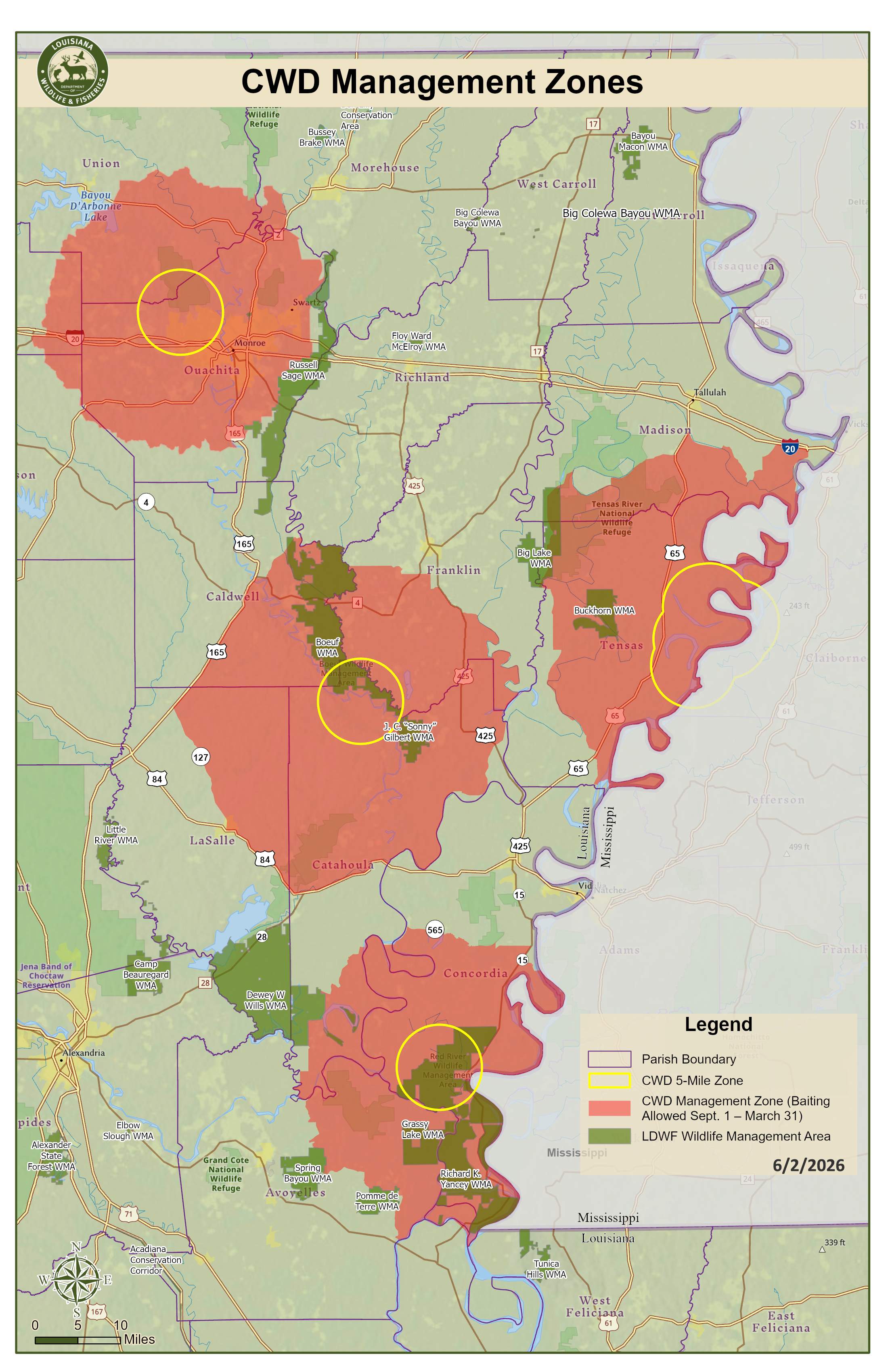
Baton Rouge, - The Louisiana Wildlife and Fisheries Commission (LWFC) ratified a Declaration of Emergency issued by Louisiana Department of Wildlife and Fisheries (LDWF) Secretary Tyler Bosworth that establishes Chronic Wasting Disease (CWD) Management Zones.
The action, which came Tuesday (June 2) during the Commission’s monthly meeting in Baton Rouge, is the result of the passage of Louisiana Senate Concurrent Resolution (SCR) 24 during the recently completed 2026 Regular Session. SCR 24 shrinks former CWD Control Area regulations and establishes a framework for CWD Management Zones.
Baiting and feeding will be allowed from Sept.1-March 31, 2027, within all current CWD Management Zones. Go to the LWFC Action Items page to see the full Declaration of Emergency.
The baiting and feeding allowance from Sept. 1-March 31 is based on achieving the department’s CWD sampling goals from the previous surveillance season. Apparent CWD prevalence rates 2.5% - 20% will result in the prohibition of baiting the following surveillance season. Surveillance seasons are July 1-June 30. Results from a surveillance season will determine baiting allowances in subsequent seasons.
The CWD Management Zone boundary utilizes roads, waterways and other natural or manmade features that serve as identifiable boundaries at a distance of 15 miles or more from confirmed CWD detections. The CWD Management Zones are comprised of a 5-mile and 15-mile zone. The regulations apply to the entirety of the CWD Management Zone.
Additional CWD detections beyond the 5-mile zone will result in changes to the 15-mile zone boundary the following surveillance season. Any new detections outside of an existing CWD Management Zone will result in a DE to establish a new zone. However, baiting and feeding restrictions would not be implemented at that time.
CWD Management Zones will be removed when sampling goals are met for three consecutive surveillance seasons without a CWD detection. The use of bait not normally ingested by deer may be used for feral hog trapping.
The export of deer carcasses outside of a CWD Management Zone is prohibited. Exceptions include: meat that is cut and wrapped; meat that has been boned out; quarters or other portions of meat with no part of the spinal column or head attached, antlers, clean skull plates with antlers, cleaned skulls without tissue attached, capes, tanned hides, finished taxidermy mounts, and cleaned cervid teeth. Deer heads may be transported out of a CWD Management Zone and to Louisiana taxidermy businesses solely for taxidermy purposes by electronic waiver and adherence to waiver guidelines.
The first CWD-positive deer was detected in Louisiana in 2022. At present, 55 CWD-positive deer have been detected, which include a single detection in Ouachita, Catahoula, and Concordia parishes, with the remaining detections from Tensas Parish.
There is no statewide feeding ban included in response to this action.
About CWD:
CWD is infectious, always fatal, and has no treatment. CWD is part of a group of diseases know as transmissible spongiform encephalopathies (TSEs). These diseases cause irreversible damage to brain tissue in deer, which leads to excessive salivation, neurological symptoms, emaciation, and death of the animal. Additionally, CWD is shed by infected deer onto the landscape and can persist in the environment indefinitely, spreading the disease to other deer. Emergency action is required to mitigate further spread of the disease.
Although CWD has not been shown to be contagious to humans, the Centers for Disease Control and the World Health Organization recommend against the human consumption of deer known to be infected with CWD. Also, it is recommended that people hunting in areas known to harbor CWD-infected deer have their deer tested for the disease prior to consuming the animals. LDWF will provide testing for hunter-harvested deer free of charge.
For more information and Control Management Area maps, go to the LDWF CWD page.