 Official Louisiana State Websites use .la.gov
  Secure .gov websites use HTTPS
Wood Duck Banding and Nesting Boxes
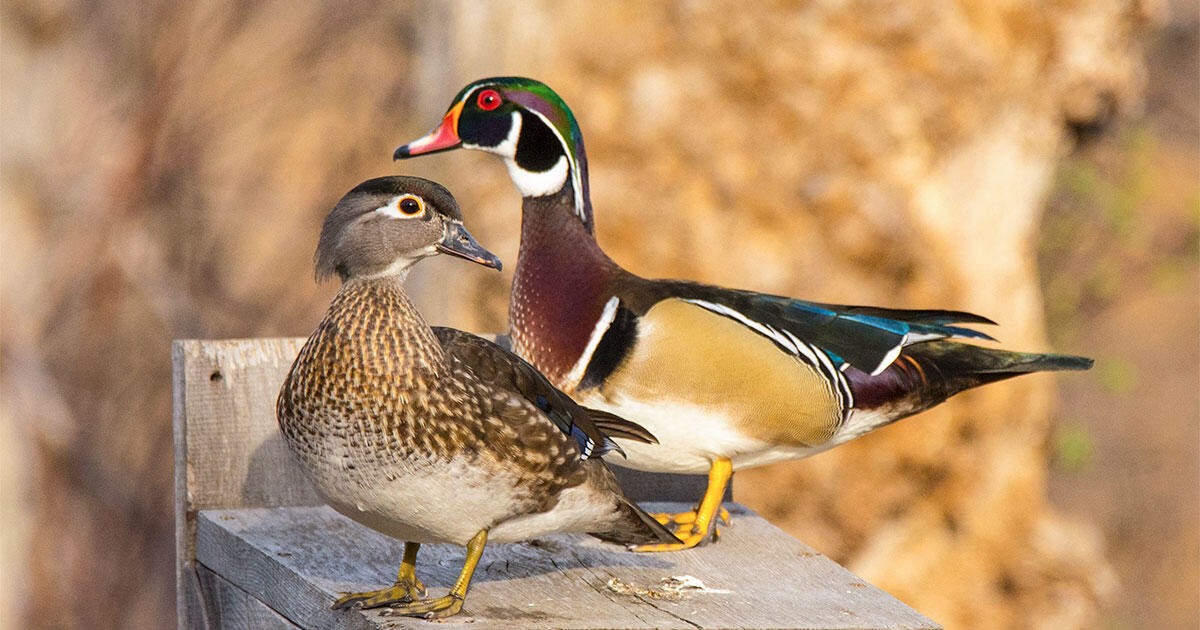
Since wood ducks live in densely vegetated habitats, it is difficult to monitor their populations through typical aerial waterfowl surveys. Instead, LDWF primarily uses banding to assess wood duck populations. Biologists attach a uniquely numbered band around the leg of a captured wood duck, record information about the duck, and release it. This information is stored in a centralized database at the Bird Banding Laboratory of the U.S. Geological Survey. Biologists use information from bands subsequently found and reported back to the Lab to assess wood duck movements between regions where they are banded and where they are recovered; estimate annual survival rates; and evaluate harvest rates.
In Louisiana, biologists typically band hens when they check wood duck nesting boxes from February through May, but the most important banding takes place during July through September, before the annual hunting season starts. During that time, biologists prepare and bait sites to attract wood ducks then capture them using rocket nets. By capturing and banding birds before the hunting season, biologists can estimate the harvest rate during the season, assuming no birds are killed or lose their bands before the season starts. Banding and recovery data from pre-season banded wood ducks also provide information on Louisiana’s local population including where they are recovered and their survival.
If you recover a banded wood duck, please report the banded duck and related information online to the Bird Banding Laboratory. Reporters will receive a certificate of appreciation for reporting banded ducks.
Estimating Harvest Rate and Survival
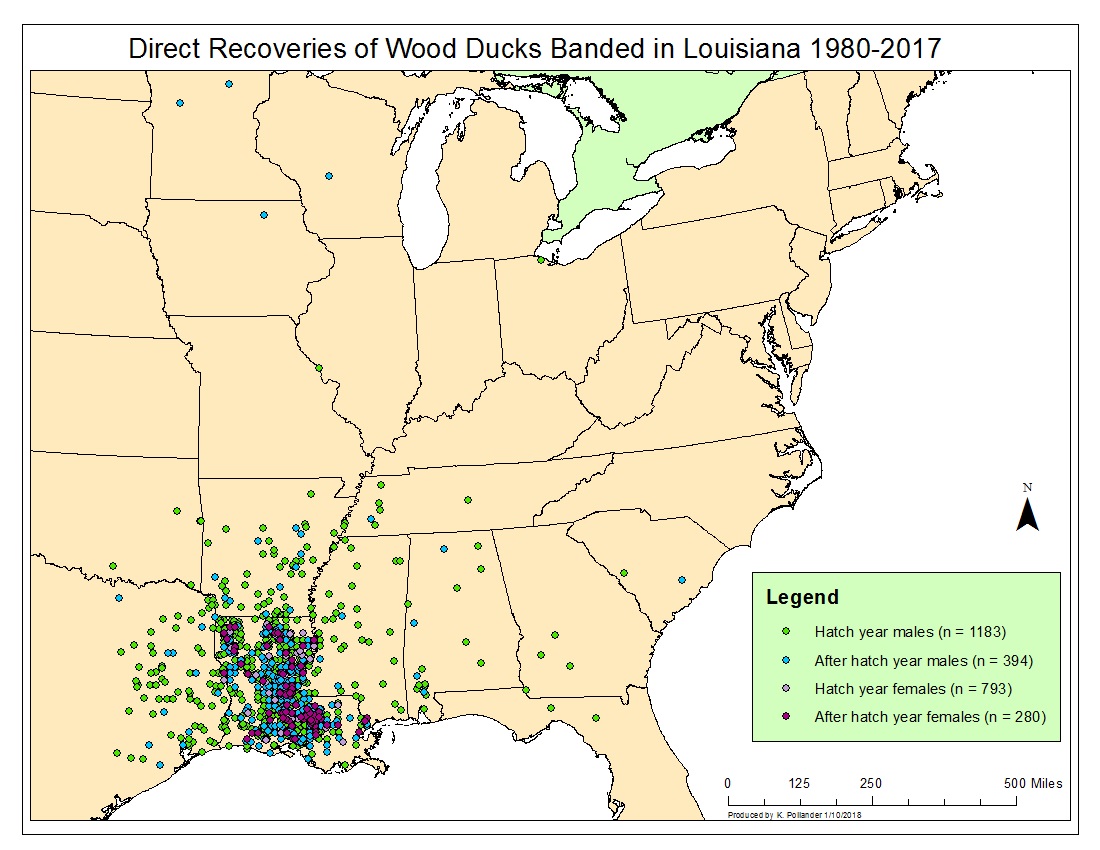
Figure 1 shows the locations of wood ducks banded in Louisiana and recovered during the hunting season immediately following the pre-season banding period each year. These are called direct recoveries. We use direct recoveries to estimate the harvest rate or the proportion of the population harvested by hunters.
Figure 2 shows indirect recoveries, or the locations of wood ducks banded in Louisiana that are recovered more than a year after the pre-season banding period. Indirect recoveries from many years of banding and recovery are necessary to estimate survival rates of Louisiana wood ducks.
These figures show a much larger distribution for indirect recoveries, and that mostly males disperse throughout the eastern United States. This is likely due to having paired during winter with a hen that migrated into Louisiana and following her when she returned to her natal breeding grounds.
Estimating Population Size
Using data from banded birds from other states and estimated total wood duck harvest, we can estimate the population size using the Lincoln-Peterson Index [Population Size = (Total Harvest) x (Harvest Rate %)]. This calculation must be done on a larger scale than just Louisiana because the harvest in Louisiana includes both local birds and those that migrated from more northern states.
Why Our Banding Efforts Matter to Hunters
The U.S. Fish and Wildlife Service currently manages the harvest of wood ducks using a harvest rate estimated by direct recoveries of pre-season banded wood ducks. If the USFWS is not confident in this estimate (according to certain statistical criteria), they will decrease the bag limit from three per day to only two. As such, it is important for states like Louisiana, where wood ducks are highly valued among hunters, to band a lot of wood ducks and for individuals to report recoveries of banded ducks to help maintain large sample sizes of pre-season banded wood ducks. This ensures that harvest rate estimates remain precise, reducing the chance of a decrease in bag limit due to uncertain data rather than an actual increase in harvest rate.

LDWF’s goal is to band at least 2,500 wood ducks per year to generate a defensible estimate of the harvest rate. In 2024 and 2025, LDWF banded 269 and 260 nesting hens, respectively, and 2,418 and 3,170 wood ducks, respectively, during the pre-season banding. Since 1990, LDWF has banded more wood ducks than any other southeastern state.
Wood Duck Nesting Boxes
Research in wetland forests in the southeast, including Louisiana, indicated that suitable nesting cavities for wood ducks were very limited, which in turn, limited populations of wood ducks.
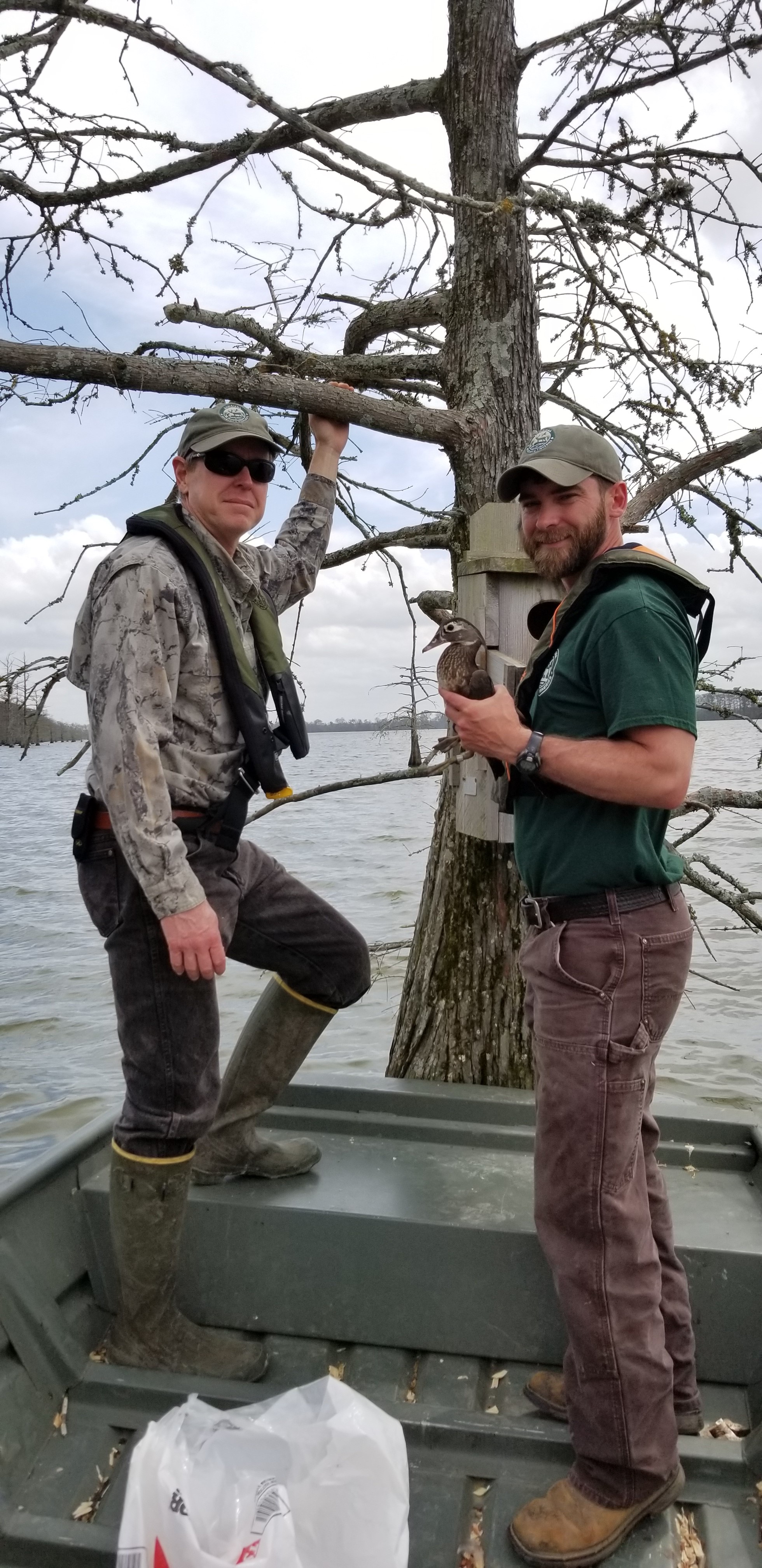
In 1990, LDWF started installing wood duck nesting boxes on LDWF wildlife management areas and select private wetlands, state parks, and U.S. Army Corps of Engineers properties to increase nesting habitat for wood ducks. Boxes with sheet metal predator guards to protect nesting hens are mounted on pipe donated by oil companies and placed in or near wetlands with good brood habitat to increase survival rates of young. We focus on sites with shallow water during early spring and summer with emergent vegetation or shrubs to provide escape cover for ducklings as well as submerged aquatic vegetation to provide protein-rich invertebrate foods needed for body and feather growth. Our goal is to maintain and monitor 2,000 wood duck nesting boxes.
Staff check boxes at least twice a year to monitor annual production. They also band nesting females when they encounter them—this is the largest source of banded adult females. From monitoring data, we have learned that nesting boxes are increasing local breeding populations of wood ducks and increasing use of our WMAs by wood ducks. Hooded merganser nesting in wood duck boxes is also increasing on some WMAs, and the expanding population of black-bellied whistling ducks are increasingly using nesting boxes later in the summer.
LDWF also provides technical assistance to private landowners who would like to enhance wood duck production on their property. Biologists evaluate the suitability of property for brood habitat and the need for annual maintenance.