Official Louisiana State Websites use .la.gov
  Secure .gov websites use HTTPS
Bird The Boot Challenge
Calling all Birders to Join The Challenge
What is the Bird the Boot Challenge?
This is a statewide birding challenge hosted by the Louisiana Department of Wildlife and Fisheries Geaux Play Outdoors program. It’s designed to get you outside to explore Louisiana’s incredible birdlife.
Who is it for?
Everyone. Whether you’re brand new to birding or a seasoned birder, there’s a challenge category for you (and maybe even a prize!).
What makes Louisiana great for birding?
Louisiana is packed with diverse habitats, from coastal marshes and cypress swamps to pine forests and bottomland hardwoods, supporting a wide variety of bird species.
How does the challenge work?
Pick a category, start exploring, and track your bird sightings. Each category offers a different way to participate, so you can choose what fits your style.
Why should I participate?
- Discover new places across the state
- Build your birding skills
- Enjoy a little friendly competition
- Contribute to real-world bird data and conservation efforts
Are there prizes?
Yes! Winners in each category will receive:
- A collectible 2026 Bird the Boot Challenge embroidered patch
- A certificate of accomplishment
- Recognition on the website
- Birding gear and other fun items
Do I need experience to join?
Not at all. This challenge is designed to help beginners get started while still offering something fun for experienced birders.
Important Dates
Registration for the Bird the Boot Challenge has closed for 2026.
Print your 2026 participation certificates now.
For questions about the Bird the Boot Challenge, contact birdtheboot@wlf.la.gov
House Wrens (Backyard Birding) Category
House Wrens – The House Wrens challenge can be done in your own backyard! This challenge is suitable for any level of birder. So no matter the reason for staying home, don’t miss your chance to help LDWF collect valuable bird data that will contribute to bird conservation and science. To accomplish this challenge, you must meet all of the challenge requirements (see House Wrens rules below).
Participant category – Team event only (household); Note: individual is also considered a team/household
Cost: No charge. It requires participants to create an LDWF account and obtain an LDWF#.
Prizes: All participants who fulfill the Challenge requirements and submit the information properly are entered into a drawing. The winning team will receive a 2026 LDWF Bird the Boot Challenge patch and an assortment of fun and useful birding items. All participants completing the challenge will be able to download a 2026 Bird the Boot Accomplishment Certificate.
- All bird sightings must occur at participant’s house.
- All bird sightings must occur between May 15, 2026 and June 1, 2026.
- Birds must be conclusively identified by sight or sound.
- AI and identification apps (Merlin, BirdNET, iNaturalist, AI binoculars, etc.) may not be used for the sole purpose to identify birds. They can only be utilized to confirm an identification the birder already believes they have made.
- Birds must be alive, wild, and unrestrained.
- Electronic or recorded bird calls may not be used.
- Pishing and other bird sounds made by mouth are allowed.
- All are required to follow birding ethics.
- Team: (household) – Bird documenting rules that apply to teams two and larger:
- Two-member team - both members must positively identify the bird (sight or sound) before counting the species
- If team is composed of three or more, the majority of the challenge members must individually, positively identify the bird (sight or sound) before counting the species. Example for a team of five – three must positively identify the species on their own before it can be counted.
- Each team utilizing eBird must submit at least three eBird checklists from their home location. Additionally, teams must document at least 15 bird species in their final trip report.
- For this challenge, paper checklists or digital eBird submissions are acceptable. See submission requirements below. Participants must follow eBird’s best practices
- FYI - A new checklist can be started after every observation hour or daily.
- If a species is flagged by eBird as rare, the team must add additional documentation in the form of either photos or sound recordings. Written descriptions alone will not be acceptable for rare birds reported in this category. A rare bird sighting must be accepted by an eBird reviewer to count for the challenge.
- Exotic species classified as “escapee” in Louisiana will not be included in your species count. Virtually all of these will be flagged as “rare” by eBird (one exception is Muscovy Duck, which is not flagged as rare in eBird but is considered “escapee” and thus will not count).
Two available options: use eBird or submit a paper checklist.
Option 1 – eBird:
- Team (household) must submit at least three eBird checklists from their home location. Additionally, teams must document at least 15 bird species in their final trip report.
- The team will not share individual eBird checklists with LDWF for the challenge category. Instead, after the challenge concludes, the team leader must create a Trip Report that includes all of your team’s checklists. If you participate on two or more challenge teams, separate Trip Reports must be submitted for each team.
- After all challenge checklists have been submitted to eBird, the team leader that created the Trip Report must:
- Name your Trip Report according to the appropriate challenge category title, “LDWF Birding Challenge - House Wrens.” The Trip Report narrative must include your team name and the names of team members.
- In each Trip Report, under Edit > Add people, be sure to invite the eBird username: LABirdingChallenge
- Ensure that only checklists to be included for your LDWF Birding Challenge team are included for your Trip Report(s); be sure to uncheck any checklists that are not for your LDWF Birding Challenge team.
- Ensure that the Trip Report’s visibility is set to Public, and email the Trip Report link to birdtheboot@wlf.la.gov with the email subject “House Wrens Trip Report - [Your Team Name]” by 11:59 p.m. CDT on June 12, 2026, to be considered for a prize drawing.
Option 2- Paper Checklist:
- Teams (households) choosing to submit paper checklists are required to bird watch for a minimum of three hours (this substitutes for three eBird checklists) during the contest period and document at least 15 bird species.
- Required details on the paper checklist:
- Team name and names of team members
- Home address, phone number, and e-mail (if available)
- Date(s) and time(s) of observations
- Must include the number of individuals seen per species. Example: 18 northern cardinals, 5 house sparrows, 2 Carolina wrens, 8 brown-headed cowbirds, 1 pine warbler, etc.
- Download and print the official Louisiana bird checklist.
- E-mail the final completed checklist back to birdtheboot@wlf.la.gov
Or mail to:
Louisiana Department of Wildlife and Fisheries
c/o Geaux Play Outdoors – LDWF Birding Challenge
200 Dulles Drive
Lafayette, LA 70506
All completed checklists must be postmarked by June 12, 2026. Include your team name and team members on the checklist.
Feather Finders Category
Feather Finders – The Feather Finders challenge is best suited for beginner and intermediate birders; although anyone can participate. This challenge focuses on simply enjoying the outdoors and visiting your favorite WMA or new ones near you. The goal is to complete all of the challenge requirements (see Feather Finder rules below).
Participant category – Team event only (two to five people)
Cost: WMA Access Permit - $20 per adult participant (18 and older). Youth 17 and younger are free. If you already have a WMA Access Permit or a license containing it, no additional purchase is required.
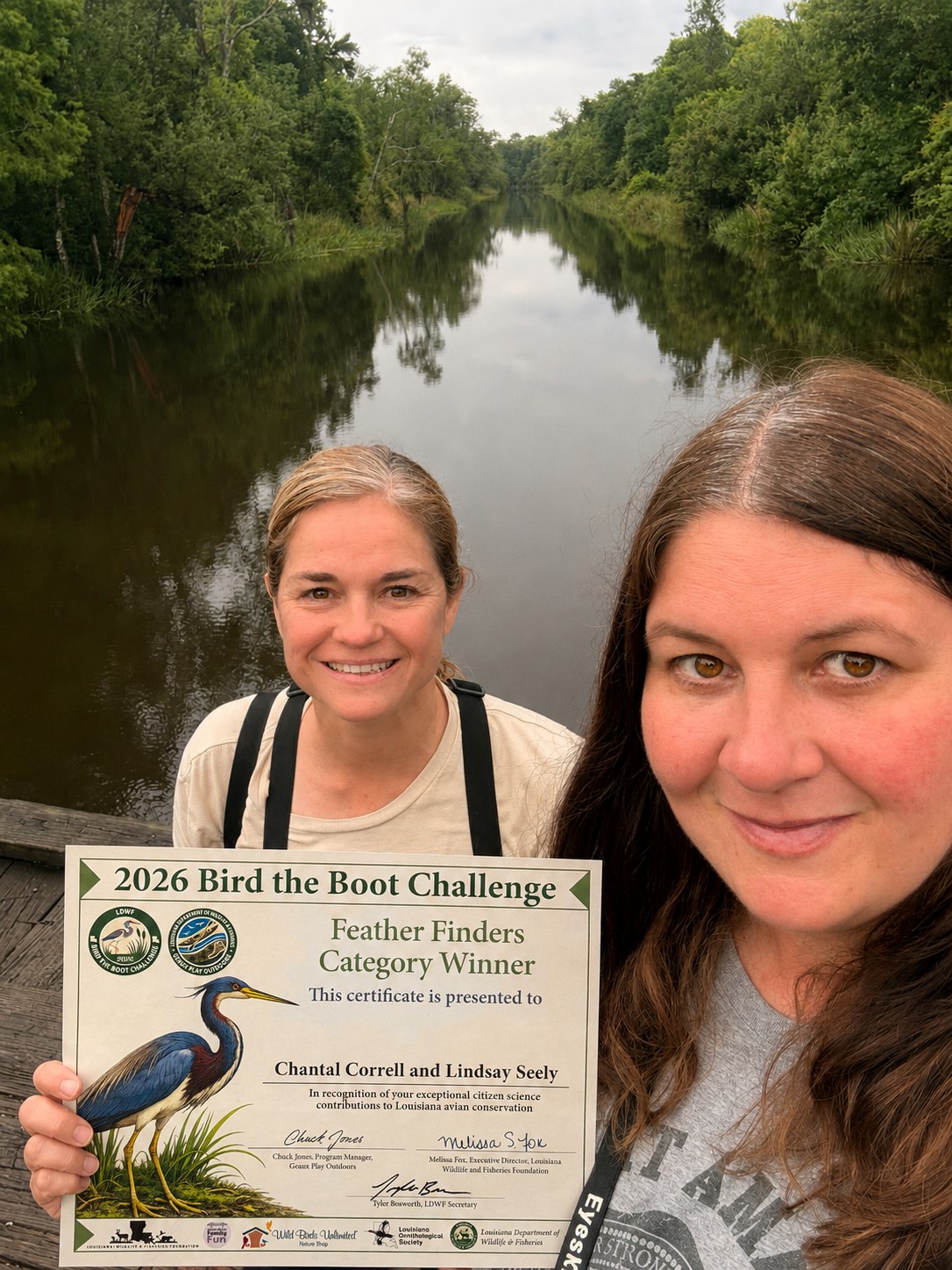
Prizes: All participants who fulfill the Challenge requirements and submit the information properly are entered into a drawing. Winning team will receive a 2026 LDWF Bird the Boot Challenge patch and an assortment of fun and useful birding items. All participants completing the challenge will be able to download a 2026 Bird the Boot Accomplishment Certificate.
- All bird sightings must occur on approved LDWF lands. See list of approved locations.
- Participants 18 years and older must obtain a WMA access permit or a license containing such.
- Users must follow LDWF requirements and check in and out of the WMA via paper cards at kiosk station, web portal, or by utilizing the Check-In/Check-Out app (Download Apple App or Download Google Play App).
- All bird sightings must occur between May 15, 2026, and June 1, 2026.
- Birds must be conclusively identified by sight or sound.
- AI and identification apps (Merlin, BirdNET, iNaturalist, AI binoculars, etc.) may not be used for the sole purpose to identify birds. They can only be utilized to confirm an identification the birder already believes they have made.
- Birds must be alive, wild, and unrestrained.
- Electronic or recorded bird calls may not be used.
- Pishing and other bird sounds made by mouth are allowed.
- All participants are required to follow birding ethics.
- Team:
- Two-member team - both individuals must positively identify the bird (sight or sound) before counting the species. Team members must be within speaking voice contact at all times.
- Three to five-member team - the majority of the team members must individually, positively identify the bird (sight or sound) before counting the species. Example: for a team of five, three must positively identify the species on their own before it can be counted. Team members must be within speaking voice contact at all times.
- Each team must submit at least three eBird checklists from any LDWF-managed land location. Additionally, teams must document a minimum of 20 bird species in their final trip report. See submission requirements below:
- For this challenge, you will be submitting eBird checklists and will follow eBird’s best practices.
- FYI - A new checklist can be started after every observation hour, daily, or when you travel beyond five miles.
- If a species is flagged by eBird as rare, the team must add additional documentation in the form of either photos or sound recordings. Written descriptions alone will not be acceptable for rare birds reported in this category. A rare bird sighting must be accepted by an eBird reviewer to count for the challenge.
- Exotic species classified as “escapee” in Louisiana will not be included in your species count. Virtually all of these will be flagged as “rare” by eBird (one exception is Muscovy Duck, which is not flagged as rare in eBird, but is considered “escapee” and thus will not count).
- Team must submit at least three eBird checklists from any LDWF managed land location. Additionally, teams must document at least 20 bird species in their final trip report.
- The team will not share individual eBird checklists with LDWF for the challenge. Instead, after the challenge concludes, the team leader must create a Trip Report that includes all of the team’s checklists. If you participate on two or more challenge teams, separate Trip Reports must be submitted for each team.
- After all challenge checklists are submitted to eBird, the team leader who created the Trip Report must:
- Name your Trip Report according to the appropriate challenge category title, “LDWF Birding Challenge – Feather Finders.” The Trip Report narrative must include your team name and the names of team members.
- In each Trip Report, under Edit > Add people, be sure to invite the eBird username: LABirdingChallenge
- Ensure that only checklists to be included for your LDWF Birding Challenge team are included for your Trip Report(s); be sure to uncheck any checklists that are not for your LDWF Birding Challenge team.
- Ensure that the Trip Report’s visibility is set to Public, and email the Trip Report link to birdtheboot@wlf.la.gov with the email subject “Feather Finders Trip Report - [Your Team Name]” by 11:59 p.m. CDT on June 12, 2026, to be considered for a prize drawing.
Eagle Eyes Challenge Category
The Eagle Eyes challenge is for birders who love the “search.” This is a highest species count challenge. If you like the thrill of competition, this one is for you! This is a statewide challenge and birding must occur on Louisiana Department of Wildlife and Fisheries (LDWF) managed lands. Participants may compete as an individual, pair, or team. The challenge is to identify and document as many species as possible.
Participant categories:
Overall highest species count – Individual
Overall highest species count – Pair
Overall highest species count – Team
Cost: WMA Access Permit - $20 per adult participant (18 and older). Youth 17 and younger are free. If you already have a WMA Access Permit or a license containing it, no additional purchase is required.
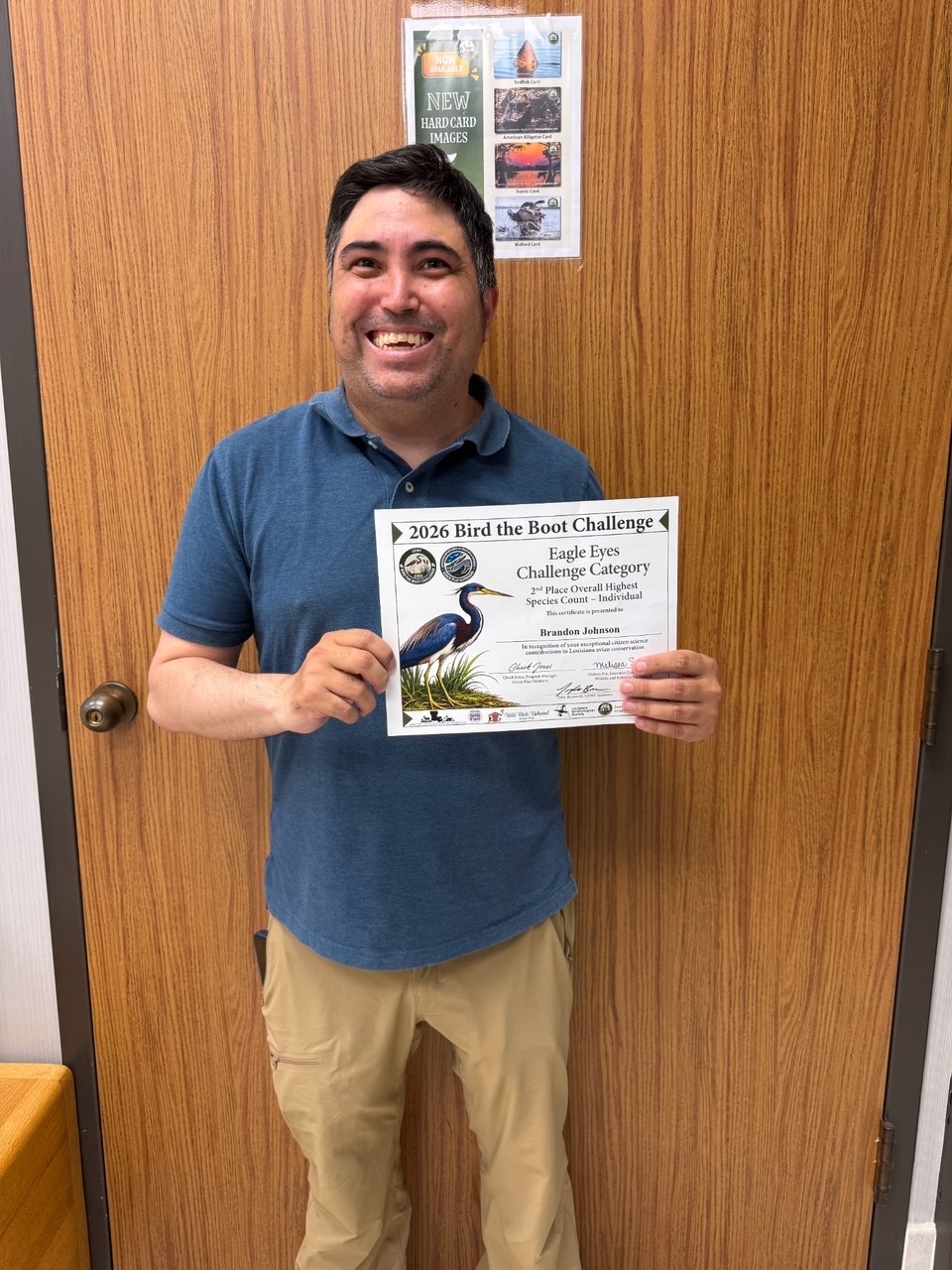
Prizes: Winning participants will receive a printed certificate documenting their high species count accomplishment, a collectible 2026 LDWF Bird the Boot Challenge patch, webpage recognition, and an assortment of fun and useful birding items. All participants completing the challenge will be able to download a 2026 Bird the Boot Accomplishment Certificate.
- All bird sightings must occur on approved LDWF lands. See a list of approved locations.
- Participants 18 years and older must obtain a WMA access permit or a license containing such.
- Users must follow LDWF requirements and check in and out of the WMA via paper cards at kiosk station, web portal, or by utilizing the Check-In/Check-Out app (Download Apple App or Download Google Play App).
- All bird sightings must occur between May 15, 2026 and June 1, 2026.
- Birds must be conclusively identified by sight or sound.
- AI and identification apps (Merlin, BirdNET, iNaturalist, AI binoculars, etc.) may not be used for the sole purpose to identify birds. They can only be utilized to confirm an identification the birder already believes they have made.
- Birds must be alive, wild, and unrestrained.
- Electronic or recorded bird calls may not be used.
- Pishing and other bird sounds made by mouth are allowed.
- All participants are required to follow birding ethics.
- Pairs - both individuals must positively identify the bird (sight or sound) before counting the species. Pairs must be within speaking voice contact at all times.
Teams – the majority of the team members must individually, positively identify the bird (sight or sound) before counting the species. Example for a team of five – three must positively identify the species on their own before it can be counted. Teams members must be within speaking voice contact at all times. - An individual, pair, or team must submit at least five eBird checklists from any LDWF-managed land. See submission requirements
- If a species is flagged by eBird as rare, the team must add additional documentation in the form of either photos or sound recordings. Written descriptions alone will not be acceptable for rare birds reported in this category. A rare bird sighting must be accepted by an eBird reviewer to count for the challenge.
- Exotic species classified as “escapee” in Louisiana will not be included in your species count. Virtually all of these will be flagged as “rare” by eBird (one exception is Muscovy Duck, which is not flagged as rare in eBird, but is considered “escapee” and thus will not count).
- An individual, pair, or team must submit at least five eBird checklists from any LDWF managed land location.
- The individual, pair, or team will not share individual eBird checklists with LDWF for challenge categories. Instead, after the challenge concludes, the team leader must create a Trip Report that includes all of your individual, pair, or team’s checklists. If you participate on two or more challenge teams, separate Trip Reports must be submitted for each team.
- After all challenge checklists are submitted to eBird, the team leader who created the Trip Report(s) must:
- Name each Trip Report according to the appropriate challenge category title, "LDWF Birding Challenge – Eagle Eyes Individual", "LDWF Birding Challenge – Eagle Eyes Pair", or "LDWF Birding Challenge – Eagle Eyes Team."
- In each Trip Report, under Edit > Add people, be sure to invite the eBird username: LABirdingChallenge
- Ensure that only checklists to be included for your LDWF Birding Challenge team are included for your Trip Report(s); be sure to uncheck any checklists that are not for your LDWF Birding Challenge team.
- Ensure that the Trip Report’s visibility is set to Public, and email the Trip Report link to birdtheboot@wlf.la.gov with the email subject “Eagle Eyes Trip Report - [Your Team Name]” by 11:59 p.m. CDT on June 12, 2026, to be considered for a prize drawing.
Celebrate your participation in the 2026 Bird the Boot Challenge by clicking on a certificate using the links to the right. Simply add your name and print your certificate as a lasting reminder of your birding accomplishment.
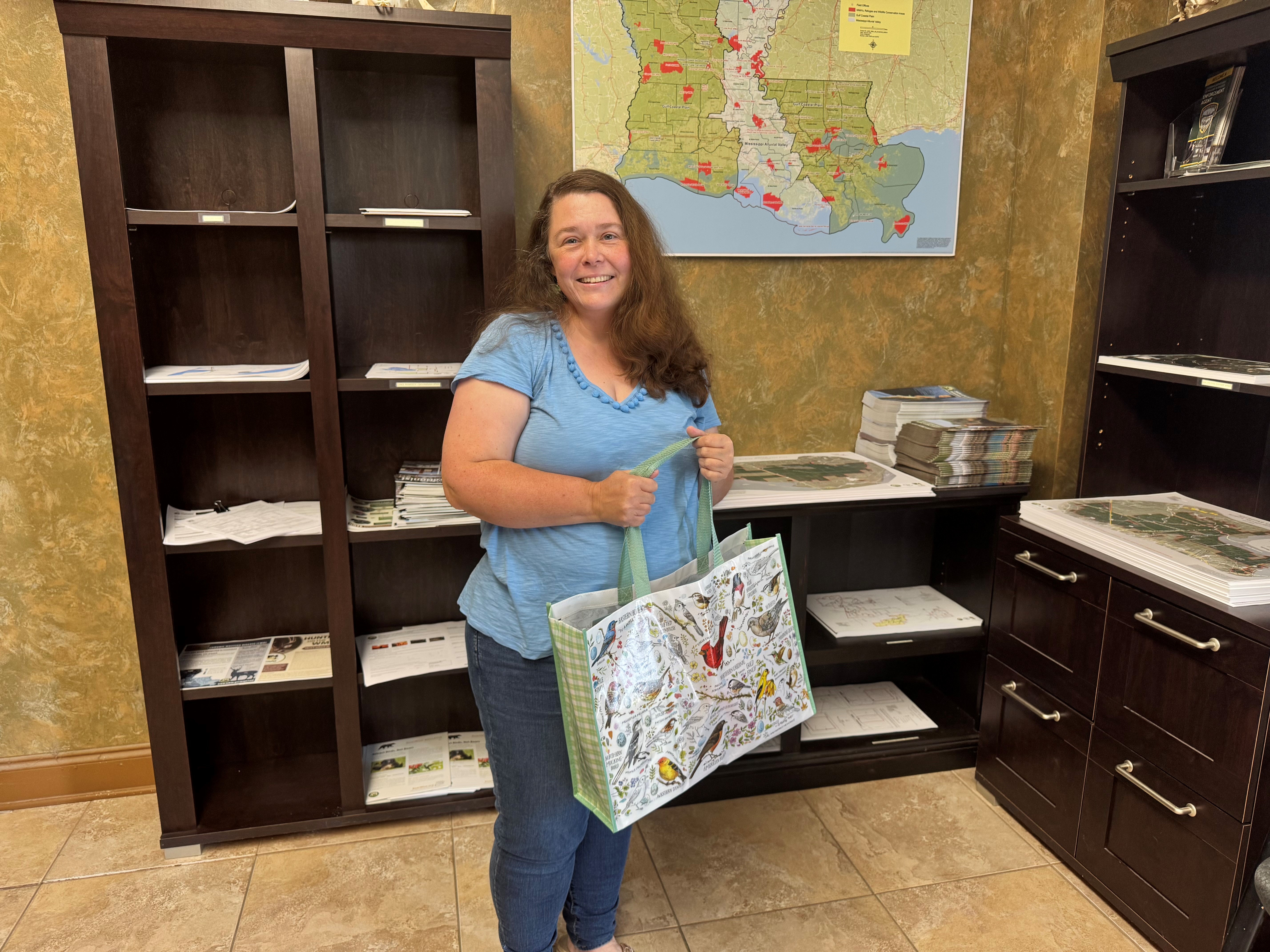
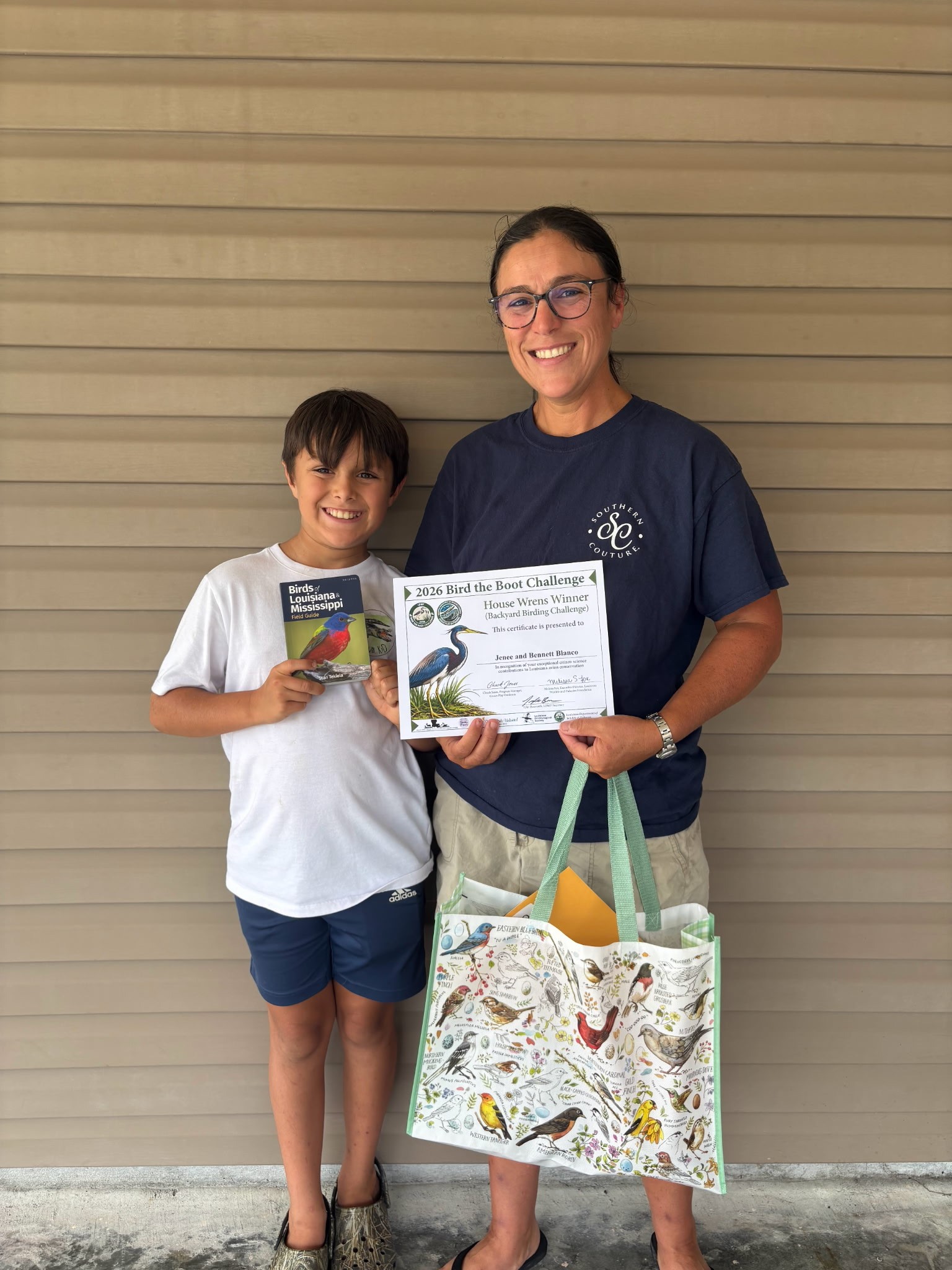
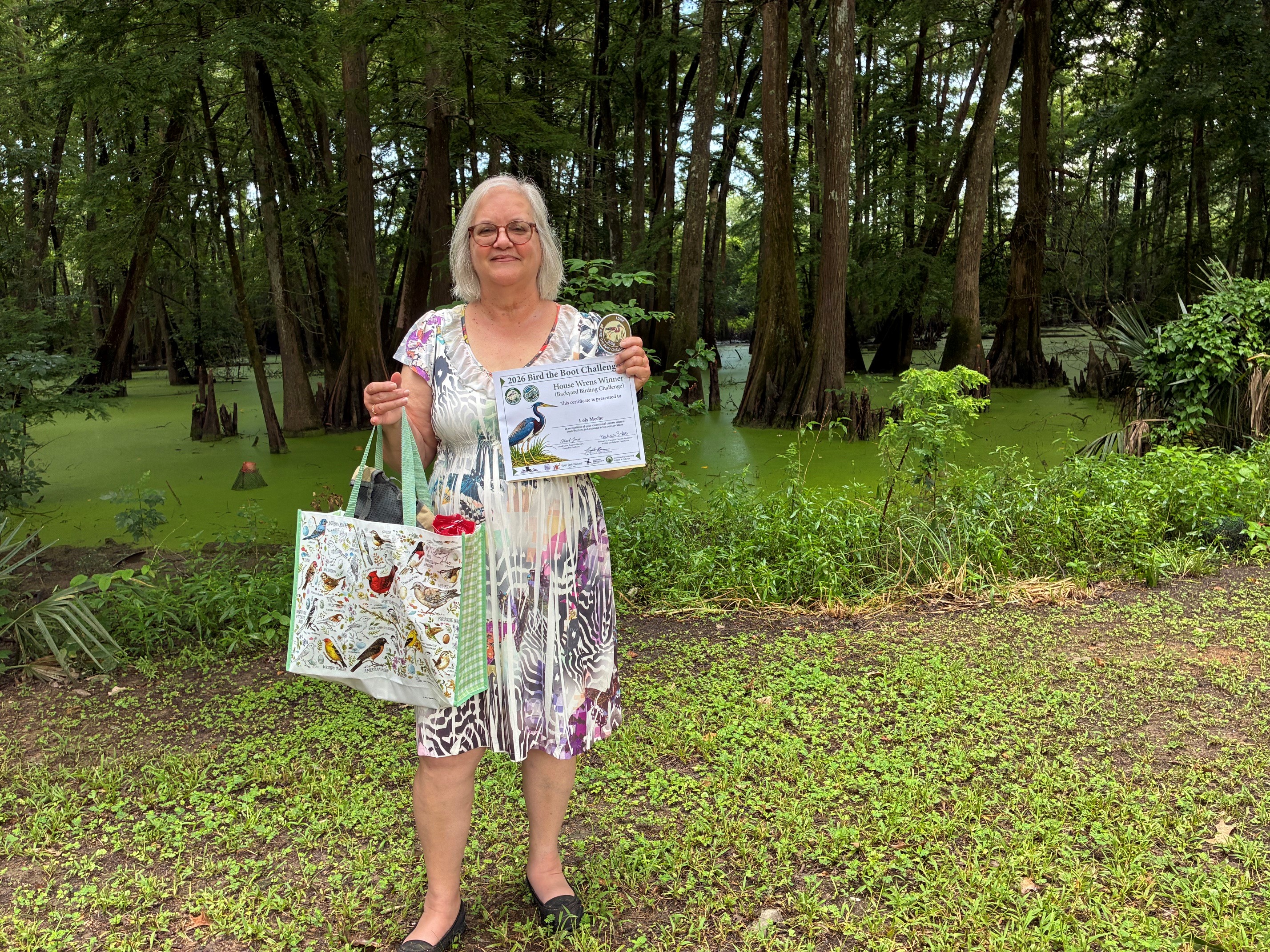
2026 Bird the Boot Winners
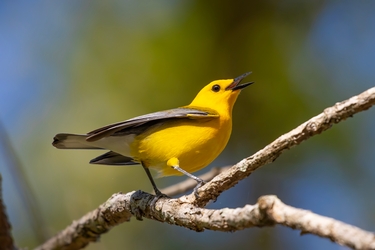
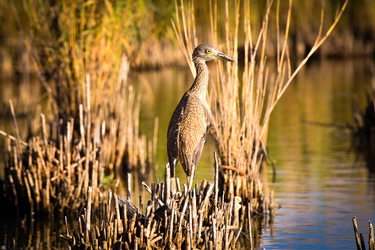
Birding in Louisiana
Thank you to the sponsors who have made our Bird the Boot Challenge possible: