 Official Louisiana State Websites use .la.gov
  Secure .gov websites use HTTPS
Cost-Sharing Assistance Available to Landowners for Longleaf Pine Restoration and Management
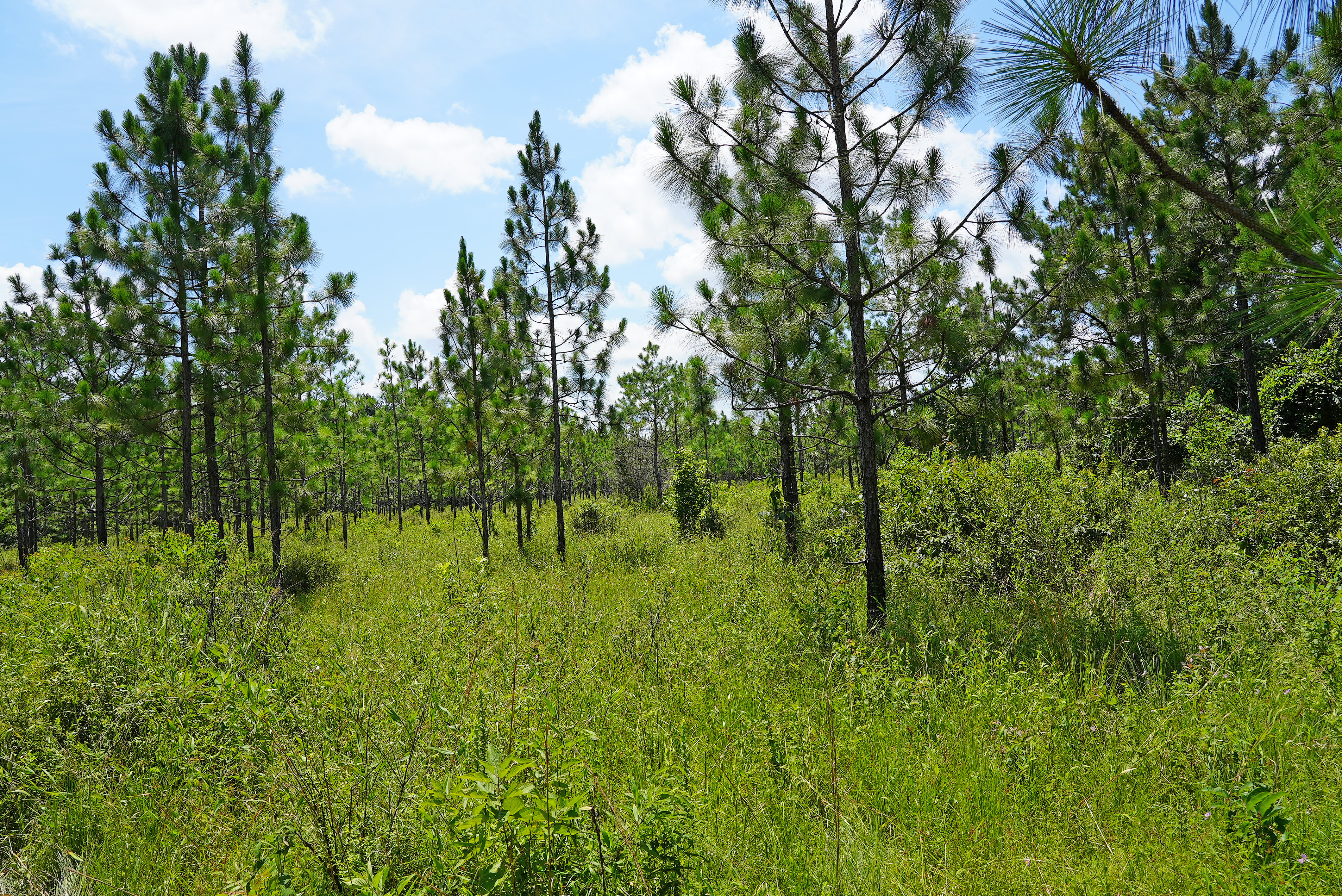
Baton Rouge, - The Louisiana Department of Wildlife and Fisheries, along with the National Fish and Wildlife Foundation, The Nature Conservancy, the National Wild Turkey Federation, the Louisiana Department of Agriculture and Forestry and the United States Fish and Wildlife Service, conducted a Longleaf Pine Restoration and Management Landowner Field Day and Workshop June 27 at the Marsh Bayou WMA in Evangeline Parish.
Longleaf pine forests offer a number of ecological and economic benefits. Longleaf pine savannahs are among the most diverse ecosystems in the world, with well-maintained sites providing optimum habitat for turkeys, quail, deer and numerous other game and non-game species.
At its peak, longleaf pine covered 90 million acres, with 60 million acres across the Southeastern U.S. By the mid-1900s, more than half of that forest was gone. By 1995, only approximately 3 million acres of longleaf pine remained, and most of that was in poor condition. Since that time, reforestation efforts have been started across the Southeastern U.S., including west-central Louisiana, resulting in roughly 4 million acres of longleaf pine.
Participating landowners were transported into the field to see the results of efforts to restore diverse longleaf pine ecosystems. The objective of the field day was to explain the environmental benefits of longleaf pine restoration in the area, show that it can be done effectively, share lessons learned and encourage private landowners to join in efforts to restore longleaf pine on their property. Landowners were also informed of the economic benefits of growing longleaf pine and financial assistance programs available to assist in the cost of establishing and maintaining a longleaf ecosystem.
Following the in-field tour at Marsh Bayou WMA, participants heard from officials with a variety of state and federal agencies about cost share programs as well as support available to private landowners who choose to participate in longleaf restoration efforts.
The West-Central Louisiana Ecosystem Partnership (WLEP) is a multi-agency, industry, and private landowner partnership formed to restore longleaf pine and other ecosystems in west-central Louisiana, including Allen, Beauregard, Natchitoches, Rapides, Sabine and Vernon parishes. The partnership provides technical assistance, including recommendations for site preparation, burning and maintenance of the longleaf forest, as well as information about various cost share programs available.
Some of the cost sharing programs mentioned include:
- Environmental Quality Incentives Program (EQIP) – A USDA/NRCS competitive program that will reimburse specific amounts for various forest management practices.
- Conservation Stewardship Program (CSP) – A USDA/NRCS program that provides incentive payments to maintain and improve conservation practices that already meet basic resource concerns.
- Conservation Reserve Program (CRP) – A USDA/FSA program that provides technical and field assistance to eligible farmers and ranchers to address soil, water, and related natural resource concerns on their land.
- Partners for Fish and Wildlife – A USFWS program that will pay for or share costs of activities to improve the habitat for rare, threatened, or endangered species, including but not limited to, site prep, tree planting, forest stand improvement, riparian fencing, prairie restoration and removal of non-native vegetation.
- Forestry Productivity Program (FPP) – A LDAF program that provides financial assistance for the establishment and improvement (including prescribed burning) of a crop of commercially valuable trees.
- National Wild Turkey Federation (NWTF) offers cost share on planting or prescribed burning longleaf pine within the WLEP parishes.
During the field tour, officials highlighted both successes and failures experienced since longleaf pine restoration efforts began at the site in 2009. They noted the initial longleaf planting in 2010 did not produce as much longleaf pine growth as expected, with a high percentage of loblolly pine and other trees and plants overtaking the areas.
LDWF Red-cockaded woodpecker Safe Harbor Coordinator Eric Baka explained officials learned from that process that good site preparation through the use of prescribed fire and herbicide application is the key to achieving a successful longleaf savannah with tree spacing sufficient to allow sunlight to reach the ground and promote the growth of a diverse underbrush to provide the food and shelter necessary for wildlife to survive.
“Fire is extremely important,” Baka said regarding prescribed burns. “It is vital to clearing out the underbrush and invasive species and encouraging new growth. And longleaf pine significantly benefits from fire. Fire actually helps the tree thrive.”
Applying lessons learned since the 2010 planting, in 2024 officials planted a 54-acre tract with 303 longleaf pine per acre using a 12 X 12 spacing with the goal of establishing wildlife habitat. The original planting in 2010 included 100 acres of land with 435 longleaf pine per acre in a 10 X 10 spacing.
On the economic side, longleaf pine produces heavier logs and a higher percentage of saw logs and poles than any other pine. The needles are longer and stronger, making them preferred for pine straw sales. Sites also provide opportunities for optimal livestock, forage and timber production. Additionally, lands can be used for hunting leases or leased out for other recreational uses, such as camping, hiking and riding trails, bird watching and other outdoor activities.
Officials also noted that longleaf pine tolerate fire well throughout their life. There is also minimized risk of catastrophic loss to insects, ice and wind, making longleaf the strongest and most durable of all pine species in the southeastern US.
For more information about longleaf pine restoration efforts or any of the programs listed above, you may contact any of the following agencies:
- Louisiana Department of Wildlife and Fisheries – CC Richmond, 337-764-4822 crichmond@wlf.la.gov or Chris Doffitt, 337-239-2193 cdoffitt@wlf.la.gov
- Louisiana Department of Agriculture and Forestry – Tyler Cloud, 225-952-8015, tcloud@ldaf.state.la.us
- The Nature Conservancy – Chris Rice, 318-237-5569, crice@tnc.org
- USDA/NRCS – 318-473-7710
- West-Central Louisiana Ecosystem Partnership (WLEP) – Dan Weber, 318-560-5725, dweber@tnc.org
- National Wild Turkey Federation – Dillon King, 870-291-5261, dking@nwtf.net
- U.S. Fish and Wildlife Service – Seth Bordelon, 337-291-3138, seth_bordelon@fws.gov