 Official Louisiana State Websites use .la.gov
  Secure .gov websites use HTTPS
Happy Hatch Day: First Whooping Crane Hatched in Louisiana Since 1939 Turns 1 Year Old
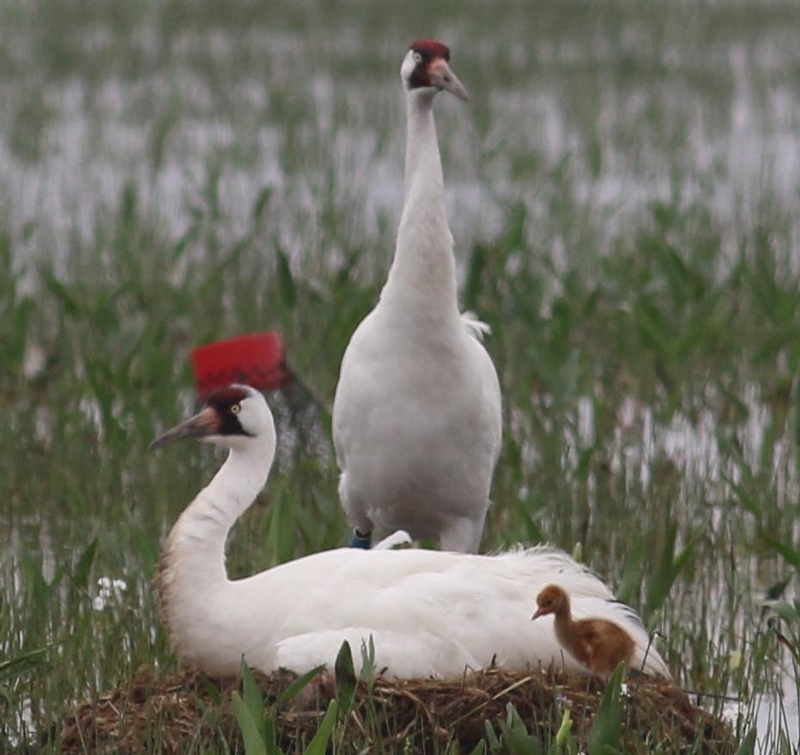
Baton Rouge, La., - It’s been one year since the hatching of a Whooping Crane chick in Louisiana, which marked the first time since 1939 of such an occurrence. To the delight of Louisiana Department of Wildlife and Fisheries (LDWF) biologists, the female bird is doing well.
The crane, hatched on April 11, 2016, makes its home in the crawfish and rice fields of Jefferson Davis Parish in southwest Louisiana. Its parents evicted the crane about two months ago but it lives not far from where they have re-nested this spring near the same spot where the chick hatched.
Under the direction of LDWF, the state is in the seventh year of a project to restore the majestic Whooping Crane, which can reach up to 5 feet in height and has a 7-8 foot wingspan. A total of 102 birds have been released in Louisiana since the project began in 2010 with 57 currently alive.
Whooping Cranes in Louisiana are designated as a non-essential, experimental population (NEP) under the provisions of the Endangered Species Act. This designation and its implementing regulation were developed to be more compatible with routine human activities, such as rice and crawfish farming, in the reintroduction area. The Whooping Crane is protected under the federal Endangered Species and Migratory Bird Treaty Acts and by Louisiana state law.
The initial cohort of birds received in 2011 marked the first presence of Whooping Cranes in the wild in Louisiana since 1950.
LDWF has partnered with the U.S. Fish and Wildlife Service, U.S. Geological Service, the Louisiana Cooperative Fish and Wildlife Research Unit and the International Crane Foundation to return the species to the state. Project funding comes from LDWF Rockefeller Wildlife Refuge funds, State Wildlife Grants Program and private/corporate donations, which are facilitated by the Louisiana Wildlife and Fisheries Foundation, along with additional partners. Chevron has been a major corporate donor in the program.
LDWF biologist Sara Zimorski, who oversees the Whooping Crane project, said last year’s hatching was an important milestone in the endeavor. But the crane’s survival to its first year was a pleasant surprise, she said.
“The chick faced challenges in her first year,’’ Zimorski said. “A wing injury was a big concern for us. And being on her own, after separating from her parents, was another potentially risky time. But she’s doing well.
“The parents of this chick sent her off on her own because they were ready to nest again. And she’s adjusted. She’s in an area that provides excellent habitat and foraging opportunity. We’ve been extremely pleased with her progress.’’
The chick was one of two that hatched last spring to the same male and female. The other, however, died a month after hatching. Zimorski said that is common with Whooping Cranes as only one usually survives.
Anyone encountering a Whooping Crane is advised to observe the bird from a distance and to report their sighting to LDWF (http://www.wlf.louisiana.gov/webform/whooping-crane-reporting-form).
Once abundant in Louisiana in the 1800s, the species dwindled to two in 1945 and had disappeared by 1950 from the state.
Whooping Cranes are large-bodied, white birds similar to White Ibis, White Pelicans, and Wood Storks, all of which must be distinguished from legally-hunted Snow Geese. However, a red head and black facial markings along with a height of five feet and a wingspan of 7-8 feet make them very distinctive. In flight, Whooping Cranes display black wing tips and fully extended neck and legs, which extend well beyond the tail.
Juvenile Whooping Cranes are primarily white with some cinnamon-brown feathers remaining on their body, primarily on their head and neck. Their wing tips are black like an adult, but they lack the red head.
Anyone witnessing suspicious activity involving harassment or shooting of Whooping Cranes is advised to report that information to LDWF’s Enforcement Division by calling 1-800-442-2511 or using the tip411 program, which may offer a cash reward for information leading to arrests or convictions. To use the tip411 program, citizens can text LADWF and their tip to 847411 or download the "LADWF Tips" iPhone app from the Apple iTunes store free of charge. Citizen Observer, the tip411 provider, uses technology that removes all identifying information before LDWF receives the text so that LDWF cannot identify the sender.
Success of the Whooping Crane project is made possible through private and corporate donations. If you would like to support the Louisiana whooping crane project by making a tax deductible donation please contact Kell McInnis at the Louisiana Wildlife and Fisheries Foundation at (225) 765-5100 or kmcinnis@wlf.la.gov or visit the foundation’s website at: http://lawff.org .
Additional information on LDWF’s Whooping Crane project is available at http://www.wlf.louisiana.gov/wildlife/whooping-cranes or on the LDWF Whooping Crane Facebook page (https://www.facebook.com/lawhoopingcranes/?fref=ts). For more information, contact Sara Zimorski at szimorski@wlf.la.gov or 337-536-9400, ext. 4.