 Official Louisiana State Websites use .la.gov
  Secure .gov websites use HTTPS
Recreational Alligator Hunting
NEW: Recreational Alligator Hunting Season
On May 7, 2026, the Louisiana Wildlife and Fisheries Commission approved rules to establish a recreational alligator hunting season. Through a lottery system, this harvest will allow as many as 5,000 alligator hunters to receive two recreational alligator harvest tags for a season that will run from October 1 to October 31.
A recreational alligator hunting season has been established in Louisiana to provide Louisiana sportsmen and women with greater opportunity to utilize and enjoy this iconic species. Louisiana’s wild alligator population has reached a point of full recovery following decades of joint conservation efforts between the LDWF, landowners, hunters, and farmers. As a result of those efforts, Louisiana now has a robust alligator resource capable of providing sustainable recreational harvest opportunities to Louisiana residents without negatively impacting a highly valuable commercial industry that provides more than $250 million dollars annually to Louisiana’s economy.
This new season creates a controlled recreational harvest opportunity for resident hunters, separate from the existing commercial alligator program.
Alligator Lottery
- As many as 5,000 hunters will be selected to recreationally harvest alligators.
- Eligibility: applicants must be Louisiana residents, hunter education certified, and at least 16 years of age to apply.
- Nonresidents may participate in the hunt, but only in the physical presence of the lottery-winning hunter.
- Successful applicants receive 2 non-transferable hide tags for each zone they are awarded.
Licenses, Permits, and Fees
- Lottery Application Fee: A $50 application fee will be charged to each applicant for each zone they apply for. Applicants may be successful for more than one zone.
- Resident Alligator Sports Hunter License: $25
- Non-Resident Alligator Sports Hunter License: $150
- A recreational hunter must possess a Basic Hunting License, the Resident Alligator Sports Hunter License, valid recreational hide tag(s), and written proof of land ownership or permission. Anyone assisting them must also possess the Alligator Sports Hunter License and a Basic Hunting License.
Season
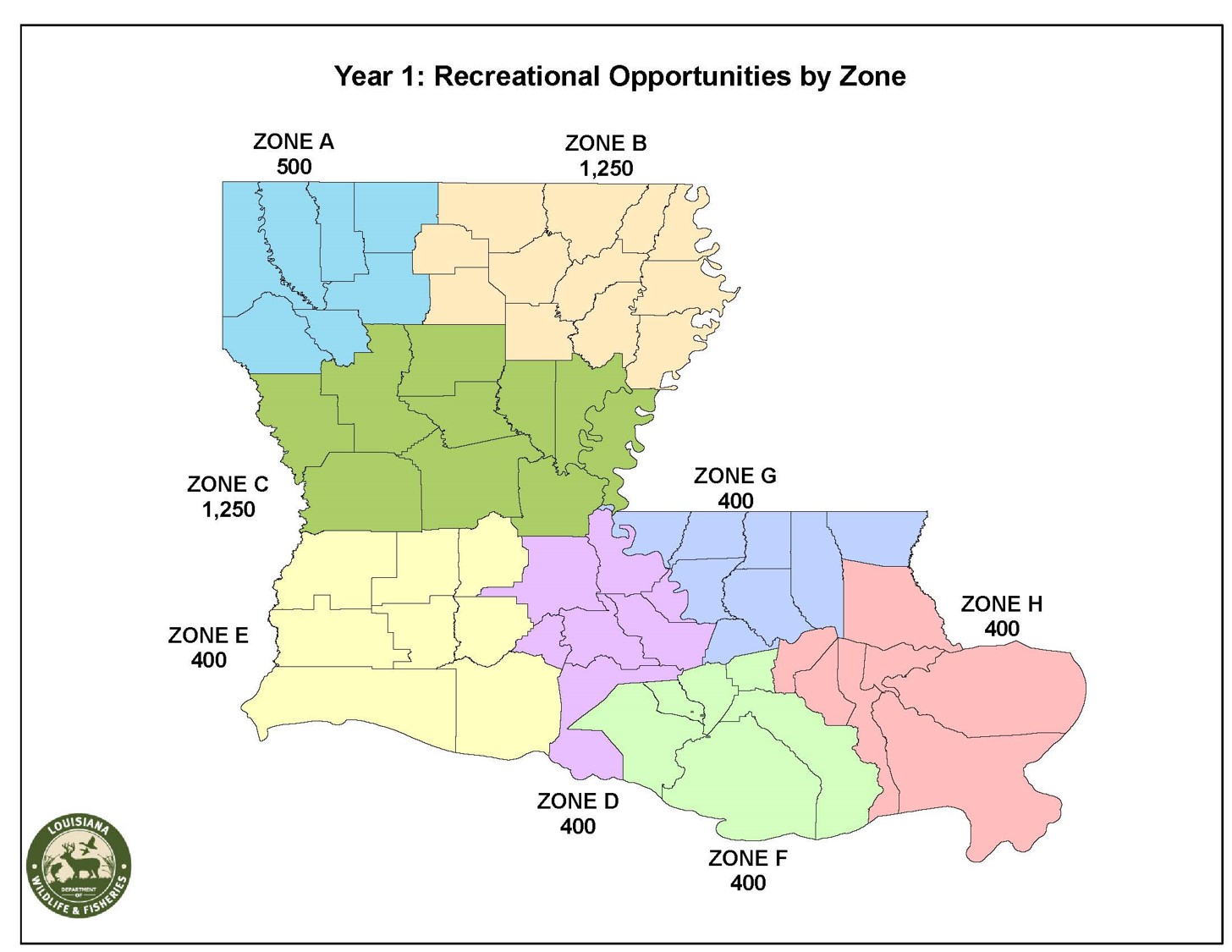
Louisiana is divided into eight recreational alligator hunting zones. Each zone opens on October 1 and closes on October 31.
| Zone | Opportunities |
|---|---|
| Zone A | 500 |
| Zone B | 1250 |
| Zone C | 1250 |
| Zone D | 400 |
| Zone E | 400 |
| Zone F | 400 |
| Zone G | 400 |
| Zone H | 400 |
Mandatory Reporting and Tagging
Immediately: Upon harvest, attach the recreational hide tag to the bottom side of the tail, approximately 6 inches from the end, and lock it with the tag's locking device. Factory-defective tags must be reported to the department.
Within 72 hours: Report the recreational hide tag number, length of the alligator, date, and parish of harvest to LDWF.
How to Validate: Hunters can validate their harvest by reporting it at one of the following:
Failure to Validate = Future Lottery Ban: Hunters who fail to validate harvested alligators will be prohibited from future participation in the recreational alligator hunting lottery.
General Rules: What a Hunter Can and Cannot Do
A Hunter Must:
- Be a properly licensed recreational alligator hunter with department-issued hide tags during open season.
- Carry valid recreational hide tags for the season and zone being hunted, plus written evidence of land ownership or landowner permission.
- Dispatch an alligator before releasing it from any taking device; properly attach the recreational hide tag immediately upon possession; remove the alligator from the harvest area.
- Dispose of alligator carcass remains properly.
- Make reasonable efforts to retrieve any hooked, wounded, or killed alligator and protect edible meat from waste.
A Hunter Must NOT:
- Sell, barter, or commingle recreationally-taken alligators, hides, meat, or parts with commercial-tag alligators. Processors must not accept recreational tags for commerce.
- Transfer, sell, assign, gift, loan, or convey a recreational hide tag — tags are nontransferable.
- Conduct, advertise, or participate in any for-hire guided alligator hunt using a recreational hide tag.
- Intentionally take a white or albino alligator
- Wantonly waste an alligator — includes failing to retrieve, intentionally abandoning edible meat, or taking without intent to reduce to possession.
- Dispose of carcass remains in public lands, rights-of- way, or waterbodies.
Wild Harvest Methods
Allowed:
- Hook and line, or snatch hook only — anchored, tethered, or originating from immovable eligible property with written landowner permission.
- Daylight hours only.
- A firearm or bang stick may be used to dispatch an alligator after it has been taken on hook and line. Dispatch may be done from a boat once secured to the line.
- Up to two (2) lines per unused tag. All lines must be labeled with the hunter's LDWF customer number on weatherproof material.
- Hooks require a line rated at least 300 pound test, securely attached, with the other end anchored to eligible property.
Prohibited
- Pole hunting is prohibited.
- Shooting of free-swimming alligators is prohibited.
- Taking outside of daylight hours or outside the special season designated by the Commission.
- Taking without valid licenses or tags, or by illegal methods.
- Exceeding the two-lines-per-unused-tag limit, or using lines not rated to 300-pound test.
- Leaving baited lines in the water outside the authorized 24-hour pre-season window or past sunset on the last day of the season.
Research Alligators
LDWF biologists have marked many alligators for research purposes. Some of these were caught in the wild, and some were released to the wild from commercial farms. These alligators have one or more notches cut out of the tail scutes and two metal tags in the webbing between the toes (usually on the back feet). If you capture a marked research alligator, record the tag number (usually 6 digits) as well as the length, tail notch(es), and sex of the alligator. Submit this information on a form provided by LDWF. Reporting information from tagged alligators is important—this information allows biologists to follow the movement, growth, and survival of alligators and informs management for continued harvests. Note that sometimes the tag is lost as the alligator grows, but the information from the tail notch still lets biologists know what year the alligator was marked.
For general information, email laalligatorprogram@wlf.la.gov.
Contact Information
If you have questions about harvesting alligators on private lands (what is considered alligator habitat, if your property qualifies for alligator tags, etc.), contact the LDWF staff responsible for administering alligator harvests on private lands for the parish in which the property is located. See contact information below.
Baton Rouge
Eric Ledet
225-763-5492
ejledet@wlf.la.gov
PO Box 98000 (mailing address)
2000 Quail Drive (physical address)
Baton Rouge, LA 70890-9000
Lafayette Zone
Ken Moreau
337-262-2080
kmoreau@wlf.la.gov
200 Dulles Drive
Lafayette, LA 70506
Lake Charles
Kori Legleu-Baxton
337-4910-2575
bbennett@wlf.la.gov
1025 Tom Watson Rd.
Lake Charles, LA 70615
Minden
Jarrod Hughes
318-371-3050
jhughes@wlf.la.gov
9961 Highway 80
Minden, LA 71055
Monroe
Will Romero
318-343-4044
wromero@wlf.la.gov
368 CenturyLink Drive
Monroe, LA 71203
New Iberia Zone
Jason Waller or Mike Dupuis
337-735-8672
jwaller@wlf.la.gov
mdupuis@wlf.la.gov
200 Dulles Drive
Lafayette, LA 70506
New Orleans
Eric Ledet
225-763-5492
ejledet@wlf.la.gov
PO Box 98000 (mailing address)
2000 Quail Drive (physical address)
Baton Rouge, LA 70898-9000
Pineville
Ben Holten, Justin Ebarb
318-487-5885
bholten@wlf.la.gov
jebarb@wlf.la.gov
1995 Shreveport Hwy.
Pineville, LA 71360
Rockefeller Zone
George Melancon
337-538-2317
gmelancon@wlf.la.gov
5476 Grand Chenier Highway
Grand Chenier, LA 70643
If you are interested in obtaining specific public land/lake alligator harvest information (selection methods, requirements, availability, etc.), contact the LDWF staff responsible for that particular public land/lake. See contact information below.
Coastal Lafayette Region
Tyson Crouch
337-735-8669
tcrouch@wlf.la.gov
200 Dulles Drive
Lafayette LA 70506
Hammond
Forest Burks
985-543-4782
fburks@wlf.la.gov
42371 Phyllis Ann Drive
Hammond, LA 70403
Lake Charles
Kori Legleu-Buxton
337-491-2575
klegleu@wlf.la.gov
1025 Tom Watson Rd.
Lake Charles, LA 70615
Minden
Jarrod Hughes
318-371-3050
jhughes@wlf.la.gov
9961 Highway 80
Minden, LA 71055
Mandalay National Wildlife Refuge
U.S. Fish and Wildlife Service
985-853-1078
3599 Bayou Black Drive
Houma, LA 70360
Monroe
Mitch McGee
318-343-4044
mmcgee@wlf.la.gov
368 CenturyLink Drive
Monroe, LA 71203
Lafayette Zone
Schuyler Dartez
337-262-2080
sdartez@wlf.la.gov
200 Dulles Drive
Lafayette, LA 70506
Pineville
Vaughan McDonald
318-487-5885
vmcdonald@wlf.la.gov
1995 Shreveport Hwy.
Pineville, LA 71360
Rockefeller Refuge
Scooter Trosclair
337-538-2276
ptrosclair@wlf.la.gov
5476 Grand Chenier Highway
Grand Chenier, LA 70643
Southwest Louisiana National Wildlife Refuge Complex
U.S. Fish and Wildlife Service
337-774-5923
swlrcomplex@fws.gov
209 Nature Rd.
Lake Arthur, LA 70549